
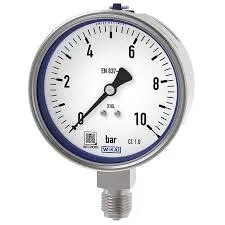
Pressure Guage
Description
A pressure gauge is an instrument used to measure the pressure of gases or liquids within a system. These devices are crucial in various industries, including manufacturing, automotive, HVAC, and process control, to ensure systems operate within safe and efficient pressure ranges.
🔧 Types of Pressure Gauges
Pressure gauges come in several types, each suited for specific applications:
Bourdon Tube Pressure Gauge: Utilizes a curved tube that straightens under pressure, moving a needle on a dial. Commonly used for general-purpose pressure measurements.
Mensor Calibration Blog
Diaphragm Pressure Gauge: Employs a flexible diaphragm that deflects under pressure. Ideal for low-pressure measurements and corrosive media.
Capsule Pressure Gauge: Features two diaphragms welded together, forming a capsule that expands or contracts with pressure changes. Suitable for measuring low pressures of gases.
Absolute Pressure Gauge: Measures pressure relative to a perfect vacuum, providing accurate readings unaffected by atmospheric pressure changes. Used in high-precision applications.
Wikipedia
Differential Pressure Gauge: Measures the difference between two pressure points, commonly used to monitor filter conditions or flow rates.
iqsdirectory.com
Bellows Pressure Gauge: Utilizes a bellows element that expands or contracts with pressure changes. Suitable for low-pressure applications.
Manometer: A simple device that uses a column of liquid to measure pressure differences. Often used in laboratory settings.
BYJU'S
🛠️ Applications
Pressure gauges are employed in various scenarios, such as:
Industrial Processes: Monitoring and controlling pressures in pipelines, reactors, and compressors.
HVAC Systems: Ensuring optimal operation of heating, ventilation, and air conditioning systems.
Automotive Industry: Measuring tire pressures and engine oil pressures.
Medical Equipment: Monitoring blood pressure and respiratory pressures.
Aerospace: Measuring cabin pressures and fuel system pressures.